HON Leak - Connectors
Published: 2026-06-24 Revised: 2026-06-24
What this report does
Calculates the connector leak rate for each selected unit under the HON (Hazardous Organic NESHAP) regulation. The report shows how many connectors were monitored, how many leaks were found, and whether the unit's leak rate exceeds the 2% DOR (Delay of Repair) threshold.
The period covered is automatically determined from the regulation's monitoring schedule — no date entry is required. The report uses the most recently completed monitoring period for each unit and regulation.
Use this report to verify HON connector compliance at the end of a monitoring period and to identify units that are at or above the 2% threshold. This report is in the Leak folder on the Reports tab.
When to use it
- Reviewing connector leak rates at the end of a monitoring period.
- Confirming that pre-existing DORs are accounted for correctly in the threshold calculation.
- Determining whether any units exceed the 2% connector DOR threshold.
Parameters
| Parameter | Description | Required | How it filters |
|---|---|---|---|
| Regulation | The HON regulation to report on | Yes | Only connectors mapped to this regulation are included |
| Unit Type | Whether to filter by Process Unit or Location Unit | Yes | Determines which unit list populates |
| Units | One or more units to include | Yes | One output row per selected unit |
| Apply 0.67 Net Deactivated Credit | Whether to apply the 0.67 deactivation credit to the denominator | Yes | When Yes, net deactivations during the period are multiplied by 0.67 and added to the denominator |
No date parameters. The monitoring period is automatically calculated from the regulation's monitoring schedule. The report uses the most recently completed monitoring period for the selected regulation and units — no start or end date entry is needed.
Columns
| Column | What it shows | Format / Notes |
|---|---|---|
| Unit | The unit name | Text |
| Monitored | Number of connectors monitored during the period | Integer |
| Act | Number of connectors activated (added) during the period | Integer |
| DeAct | Number of connectors deactivated during the period | Integer |
| Net DeAct | Net deactivations: DeAct minus Act; floored at zero | Integer; negative results are shown as 0 |
| Credit (Times 0.67) | Deactivation credit added to the denominator when the credit option is enabled | Decimal; Net DeAct × 0.67 when credit is applied; 0 when credit is not applied |
| Denominator | Total used as the bottom of the leak rate calculation | Decimal; Monitored + Credit + Pre-Existing DORs |
| Leaks Found | Number of connector leaks found during the monitoring period | Integer |
| Pre-Existing DORs | Number of connectors that had an open DOR at the start of the monitoring period | Integer |
| Total Connectors | Total number of active connectors in the unit at the end of the period | Integer |
| 2% of Total | Two percent of the total connector population, rounded to the nearest whole number | Integer; the DOR threshold ceiling |
| Excess DORs | Pre-existing DORs above the 2% threshold | Integer; max(0, Pre-Existing DORs − 2% of Total); 0 when pre-existing DORs do not exceed the threshold |
| New Comps | Number of new connectors added to the system during the monitoring period | Integer |
| Numerator | Total used as the top of the leak rate calculation | Integer; Leaks Found + Excess DORs |
| Leak Rate | Connector leak rate for the period, expressed as a percentage | Decimal (1 decimal place); Numerator ÷ Denominator × 100 |
| Period Start | First day of the monitoring period | Date |
| Period End | Last day of the monitoring period | Date |
| Frequency | Monitoring frequency assigned to the unit under this regulation | Text; e.g., "Annual", "Semi-Annual" |
What's included and excluded
Included:
- Only connectors (component type Connector) mapped to the selected regulation.
- Only components in the selected unit(s).
- Connectors monitored during the automatically determined monitoring period.
Excluded:
- Non-connector component types (valves, pumps, etc. — see related reports for those).
- Connectors classified as Exempt or HL (heavy liquid) under the regulation.
- Components not mapped to the selected regulation.
How key values are calculated
Monitoring period (auto-calculated)
The report determines the most recently completed monitoring period automatically based on the regulation's monitoring schedule. There are no date inputs — the period boundaries are derived from the regulation configuration and appear in the Period Start and Period End columns.
Denominator
The denominator represents the adjusted connector population used for the leak rate calculation:
Denominator = Monitored + Credit (Times 0.67) + Pre-Existing DORs
- Monitored — connectors for which monitoring was completed during the period.
- Credit (Times 0.67) — when the deactivation credit is enabled, net deactivations (DeAct − Act, floored at zero) are multiplied by 0.67 and added. This credit reflects connectors removed from service and reduces the effective monitored population.
- Pre-Existing DORs — connectors that already had an open DOR at the start of the period are added to the denominator (they are already being managed and count toward the total).
Pre-Existing DORs and Excess DORs
Pre-existing DORs are connectors on an active Delay of Repair at the beginning of the monitoring period. The regulation allows a 2% DOR threshold — up to 2% of the total connector population may be on DOR without penalty. Pre-existing DORs within that 2% threshold are absorbed; any amount above it becomes Excess DORs, which are added to the Numerator.
Excess DORs = max(0, Pre-Existing DORs − 2% of Total Connectors)
Numerator
Numerator = Leaks Found + Excess DORs
Leaks found during the monitoring period plus any pre-existing DORs that exceed the 2% threshold. When pre-existing DORs are within the 2% allowance, Excess DORs is 0 and the Numerator equals Leaks Found only.
Leak Rate
Leak Rate = (Numerator ÷ Denominator) × 100
Expressed as a percentage to one decimal place. A unit exceeds the HON connector threshold when Leak Rate > 2.0%.
New Comps
Connectors whose add date falls within the monitoring period. These are newly created components — this column provides context for understanding population changes during the period.
Tips and common questions
- "Why is there no date parameter?" The report automatically determines the most recently completed monitoring period from the regulation's monitoring schedule. The period dates are shown in the Period Start and Period End columns of the output.
- "What is the DOR threshold for connectors?" The threshold is 2% — twice the 1% threshold used for valves. A unit's leak rate must exceed 2.0% before it is out of compliance.
- "When should I apply the 0.67 deactivation credit?" Apply it when your facility has deactivated connectors during the period and you want to account for the reduction in the monitored population. The credit adjusts the denominator upward (adding 0.67 × net deactivations), which lowers the effective leak rate.
- "Why are Pre-Existing DORs added to both the denominator and potentially the numerator?" Pre-existing DORs are always added to the denominator because they are part of the overall connector population being managed. If they exceed the 2% threshold, only the excess portion is added to the numerator — the threshold amount is not penalized.
- "A unit has no data row." Units with no monitored connectors mapped to the selected regulation will not appear in the output. Confirm that the unit has connectors with the correct regulation assigned and that monitoring occurred during the period.
- "What does 'Pre-Existing DORs' mean in the formula?" Pre-Existing DORs are Delay of Repair records that were already open at the start of the reporting period — DORs that were approved before the period began and had not yet been closed. They are included in the denominator to credit the facility for leaks that were already under active repair at the start of the period.
Sample output
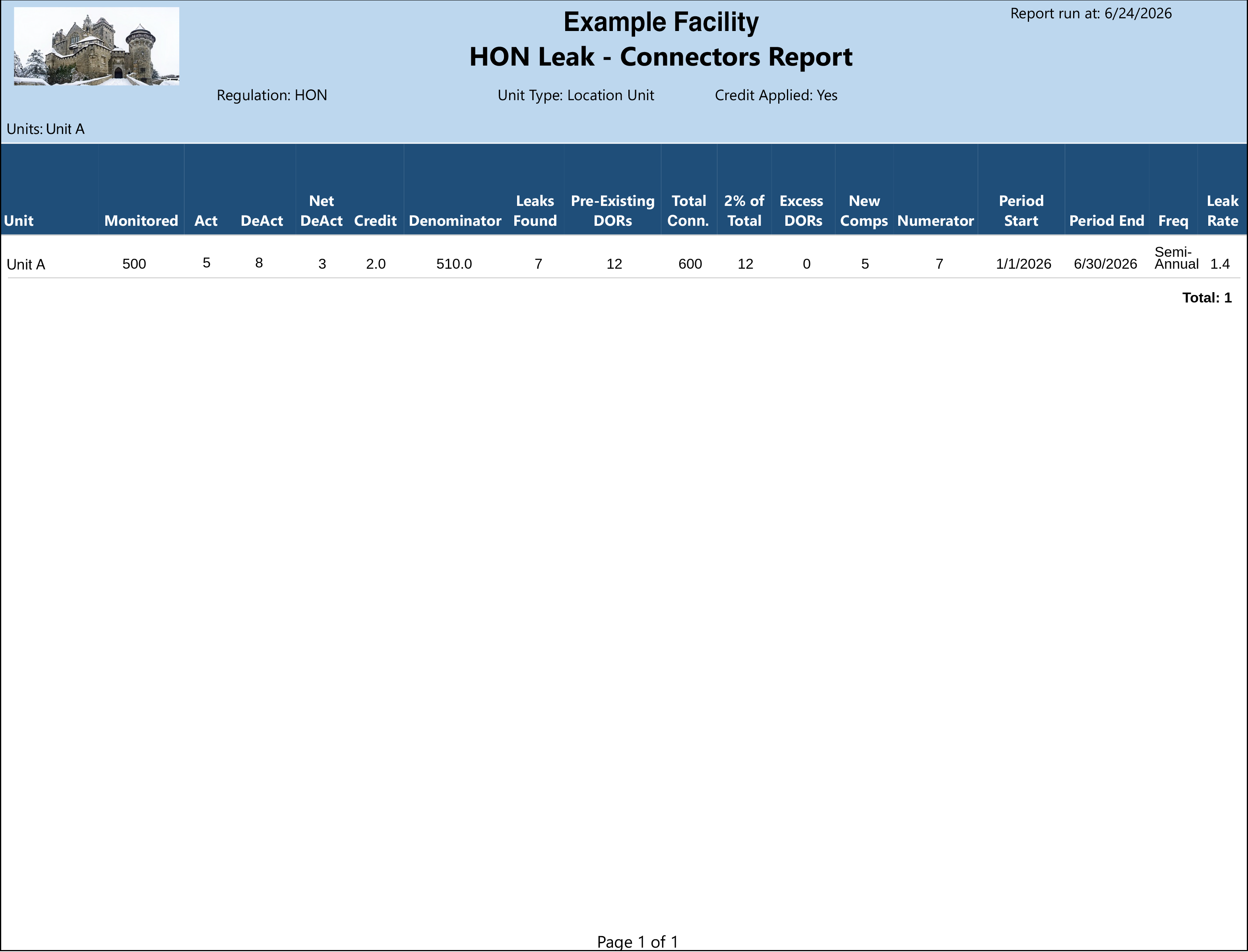
In this example: Pre-Existing DORs (12) equals exactly 2% of Total Connectors (600 × 0.02 = 12), so Excess DORs = 0 and Numerator = Leaks Found only. Leak Rate = 7 ÷ 510.0 × 100 = 1.4%, below the 2% threshold.
Output format
One row per unit. Suitable for on-screen viewing, PDF, and Excel export.
Related reports
- HON Leak Report — the primary HON leak report covering all component types with full leak detail; this report summarizes connector-specific rates.
- HON Leak - Valves — the rolling-average valve leak rate report; uses the same deactivation credit option but a different calculation method (1% threshold, rolling average across periods).
- HON Leak - Pumps — pump leak rate report; does not use the deactivation credit; subtracts leaks found on newly added pumps from both the numerator and denominator.