VVa Drift – Form 2
Published: 2026-06-18 Revised: 2026-06-18
What this report does
Reports drift check results for analyzers drifted using the VVa method, in a simplified format. Like the VVa Drift report, each row represents one gas cylinder from the morning calibration and includes up to three individual drift readings per drift event. The key differences from the standard VVa Drift report are:
- Shows a single combined drift percent (rather than separate NSPS (New Source Performance Standards) VVa and Consent Decree columns).
- Includes Probe Type and cylinder calibration time.
- Includes a Cal Note column for any comments recorded on the calibration session.
- Does not include Consent Decree compliance columns.
Use this format for VVa drift documentation when a cleaner layout is preferred, or when the Consent Decree compliance columns are not required. This report is in the Calibration folder on the Reports tab.
When to use it
- Producing VVa drift records when the Consent Decree columns are not needed.
- Reviewing VVa drift results alongside probe type and calibration notes.
- Documenting drift for submissions where a single drift percent per event is sufficient.
Parameters
| Parameter | Description | Required | How it filters |
|---|---|---|---|
| Start Date | Beginning of date window | Yes | Calibration dates on or after this date are included |
| End Date | End of the date window | Yes | Calibration dates on or before this date are included |
| Analyzers | One or more analyzers to include | Yes | Only records for the selected analyzers appear |
VVa method only. This report only shows analyzers whose drift was performed using the VVa method.
Columns
| Column | What it shows | Format / Notes |
|---|---|---|
| Analyzer ID | Analyzer device name | Text |
| Date | Date the calibration and drifts were performed | Date; facility local time |
| Calibrate | Time of the morning calibration reading | Time (H:MM:SS AM/PM) |
| Cyl. Mfr. ID | Cylinder label or serial number | Text |
| Conc. | Cylinder gas concentration in PPM | Decimal |
| Reading | Morning calibration reading in PPM | Decimal |
| Conc./Reading Diff. | Percent difference between reading and cylinder concentration | Percentage |
| Probe Type | Probe type used | Text; "Standard" or "Extension" |
| Pass | Whether the morning calibration passed | "Yes" or "No" |
| Drift 1 | Time of the mid-day (Drift 1) check | Time (H:MM:SS AM/PM); blank if no mid-day drift |
| Drift 1 Combined | All three mid-day drift readings stacked | Three values (R1 / R2 / R3); blank if no mid-day drift |
| Drift Pct. 1 | Average percent drift for Drift 1 | Percentage; blank if no mid-day drift |
| Pass | Whether Drift 1 passed | "Yes" or "No"; blank if no mid-day drift |
| Drift 2 | Time of the end-of-day (Drift 2) check | Time; blank if no end-of-day drift |
| Drift 2 Combined | All three end-of-day drift readings stacked | Three values; blank if no end-of-day drift |
| Drift Pct. 2 | Average percent drift for Drift 2 | Percentage; blank if no end-of-day drift |
| Pass | Whether Drift 2 passed | "Yes" or "No"; blank if no end-of-day drift |
| Cal Note | Any note recorded on the calibration session | Text; blank if no comment |
What's included and excluded
Included:
- Calibration records for the selected analyzers within the date range where drift method is VVa.
- Drift 1 (mid-day, Noon) VVa readings matched to the morning calibration.
- Drift 2 (end-of-day) VVa readings matched to the morning calibration.
Excluded:
- Analyzers not selected.
- Records outside the date range.
- Standard-method drift records (those appear in Analyzer Drift).
- Drift values when the morning calibration failed.
How key values are calculated
Diff.
For span gas:
Diff. = (Reading ÷ Concentration × 100) − 100
For zero gas:
Diff. = Reading × 10
Drift Pct (Drift Pct1 / Drift Pct2)
The average of the percent deviations for up to three drift readings:
Drift Pct = Average of [(R1/C − 1)×100, (R2/C − 1)×100, (R3/C − 1)×100]
Where C is either the cylinder concentration or the morning calibration reading, depending on the analyzer's calibration settings. Partial averages are used when fewer than three readings are present.
Tips and common questions
- "How does this differ from the standard VVa Drift report?" This report shows a single drift percent (Drift Pct) per event rather than separate NSPS VVa and Consent Decree columns. It also adds Probe Type, Diff., and Comment. Use the standard VVa Drift report when Consent Decree compliance columns are required.
- "Drift values are blank for a row." If no mid-day or end-of-day drift was performed for that calibration session, the corresponding columns are blank.
- "Comment is blank for most rows." A comment is only recorded when the technician entered a note on the calibration session. Most sessions will have no comment.
- "Drift values are suppressed when Pass = No." When the morning calibration did not pass, all drift columns are shown as blank — drift data against a failed calibration is not meaningful.
- "The Diff values on this form are the opposite sign from the standard VVa Drift form." This form uses the formula
(Reading ÷ Conc × 100) − 100, while the standard VVa Drift form uses100 − (Reading ÷ Conc × 100). A reading that is slightly above the certified concentration will produce a positive Diff here and a negative Diff on the standard form. Both represent the same measurement — only the sign convention differs. Use the same form consistently when comparing results across events.
Sample output
Report run for Example Facility, Start Date: 1/31/2023, End Date: 1/31/2023, Analyzer: phx42-8696.
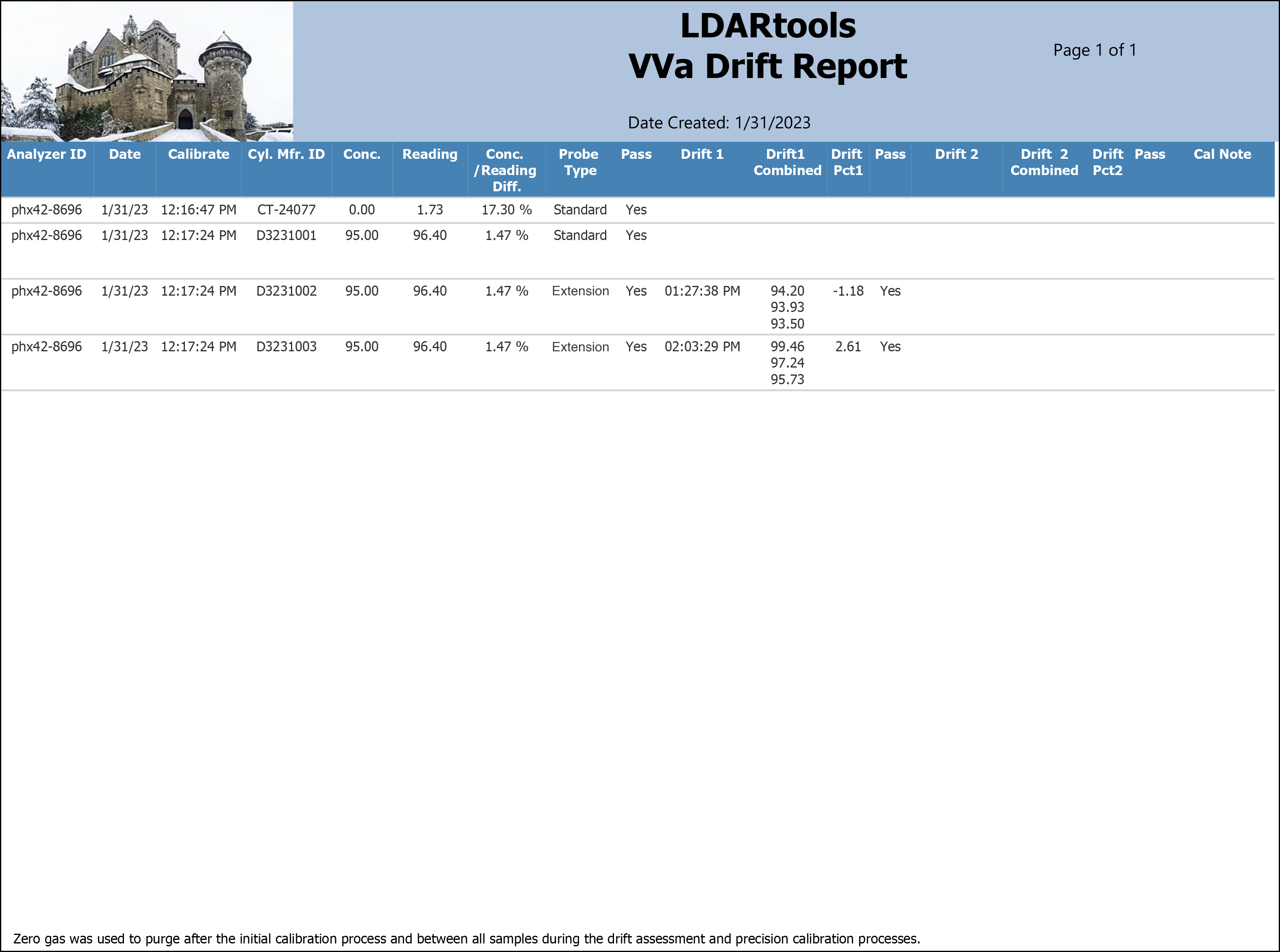
What the rows illustrate:
- Standard probe session — Calibration only; no Drift 1 or Drift 2 recorded.
- Extension probe session (12:17 PM) — Both Standard and Extension probe sessions may appear on the same date; the extension probe session includes a mid-day drift at 1:27 PM.
- Drift Pct1 = −1.18% — The single average drift percent for the mid-day check on cylinder D3231002 (95 PPM).
Output format
One row per gas cylinder per morning calibration session. Drift 1 and Drift 2 readings appear as additional columns in the same row. Suitable for on-screen viewing, PDF, and Excel export. Stacked multi-value cells (Drift1 All, Drift2 All) are best viewed in PDF or on-screen.
Related reports
- VVa Drift — full VVa drift report with separate NSPS VVa and Consent Decree compliance columns.
- Analyzer Drift — standard (non-VVa) drift report.
- Daily Calibration — morning calibration readings only.