Precision Calibration
Published: 2026-06-18 Revised: 2026-06-18
What this report does
Lists Precision Calibration results for each selected analyzer within the date range. A Precision Calibration measures the analyzer's measurement accuracy and response time for each gas cylinder by running three consecutive test readings. Each row shows one cylinder from one session — including the three individual readings, the precision error percentage, the three response times, and the average response time.
Use this report to verify that an analyzer meets accuracy and response time requirements, and to produce the documentation required before field use. This report is in the Calibration folder on the Reports tab.
When to use it
- Confirming that an analyzer passed precision calibration before beginning field work.
- Reviewing precision error and response time results for each gas range.
- Producing precision calibration records for regulatory submissions or audits.
- Generating the response time data that populates the PreCal Sticker.
Parameters
| Parameter | Description | Required | How it filters |
|---|---|---|---|
| Analyzers | One or more analyzers to include | Yes | Only precision calibration records for the selected analyzers appear |
| Start Date | Beginning of the date window | Yes | Precision calibrations on or after this date are included |
| End Date | End of the date window | Yes | Precision calibrations on or before this date are included |
Analyzer list is date-filtered. The Analyzers parameter only shows analyzers that have a Precision Calibration record in the database for the selected date range.
Columns
| Column | What it shows | Format / Notes |
|---|---|---|
| Analyzer | Analyzer Serial Number | Text: e.g., "phx42-1345" |
| Cal. Date | Date and time the precision calibration was performed | Date/Time; facility local time |
| Tech ID | Technician who performed the calibration | Text |
| Probe Type | Probe type used | Text; "Standard" or "Extension" |
| Gas | Gas type used in the cylinder | Text; e.g., "Methane", "Zero" |
| Span | Target concentration (span) of the cylinder in PPM | Integer |
| Conc. | Actual concentration of the gas cylinder in PPM | Decimal |
| Result | Whether the calibration passed | "Yes" or "No" |
| Test 1 | First test reading in PPM | Integer |
| Test 2 | Second test reading in PPM | Integer |
| Test 3 | Third test reading in PPM | Integer |
| Prec. | Precision error — average deviation of the three readings from the cylinder concentration | Percentage (absolute value); see calculation below |
| Resp. 1 | Response time for the first test (seconds to 90% of concentration) | Decimal (seconds) |
| Resp. 2 | Response time for the second test | Decimal (seconds) |
| Resp. 3 | Response time for the third test | Decimal (seconds) |
| Avg. Resp. | Average of the three response times | Decimal (seconds) |
| Anlz SN | Analyzer serial number | Text: e.g., "phx42-1345" |
| Cyl. Man. ID | Cylinder manufacturer ID / label | Text; the custom label assigned to the cylinder |
| Cyl. Exp. Date | Cylinder expiration date | Date |
What's included and excluded
Included:
- All Precision Calibration sessions for the selected analyzers within the date range.
- One row per gas cylinder per session.
- Both Standard and Extension probe precision calibrations.
Excluded:
- Analyzers not selected.
- Sessions outside the date range.
- Daily Calibration records (those appear in the Daily Calibration reports).
- Drift records.
How key values are calculated
Prec (Precision Error)
Prec = |Average(Test 1, Test 2, Test 3) ÷ Concentration × 100 − 100|
The precision error is the absolute percentage deviation of the average of the three readings from the actual cylinder concentration. A value of 0% means the three readings averaged exactly to the cylinder concentration. Lower values indicate better measurement accuracy.
For zero gas (Concentration = 0), Prec is reported as 0.
Response Times (Resp 1, Resp 2, Resp 3)
Response time is the number of seconds it takes the analyzer to reach 90% of the calibration gas concentration after the gas is introduced. Shorter response times indicate that the analyzer settles quickly on a reading.
Avg Resp
The average of Resp 1, Resp 2, and Resp 3. Partial averages are computed when only one or two of the three response times are present.
Tips and common questions
- "Some rows show Test 3 as blank." If only two tests were recorded for a cylinder, Test 3 will be blank. Prec and Avg Resp are calculated from the tests that are present.
- "Resp values are in seconds, not minutes." Response times are stored and displayed in seconds. A value of 4.00 means the analyzer reached 90% of concentration in 4 seconds.
- "What is the difference between Span and Conc?" Span is the labeled target concentration of the cylinder (e.g., 500 PPM nominal). Conc is the actual certified concentration from the cylinder certificate (e.g., 492 PPM actual). Precision error is calculated against the actual concentration.
- "The PreCal Sticker report — how does it relate?" The PreCal Sticker report generates a compact summary of average response times per cylinder for the current quarter, drawn from the same precision calibration data. It is designed to be printed and attached to the analyzer in the field.
- "Result shows No for a row." A failed precision calibration means the readings were outside the acceptable tolerance. Analyzers with a failed precision calibration (Result = No) may affect downstream drift reports — drift data collected against a failed baseline is not considered valid.
Sample output
Report run for Example Facility, Analyzer: phx42-1934, Start Date: 1/30/2023, End Date: 1/30/2023.
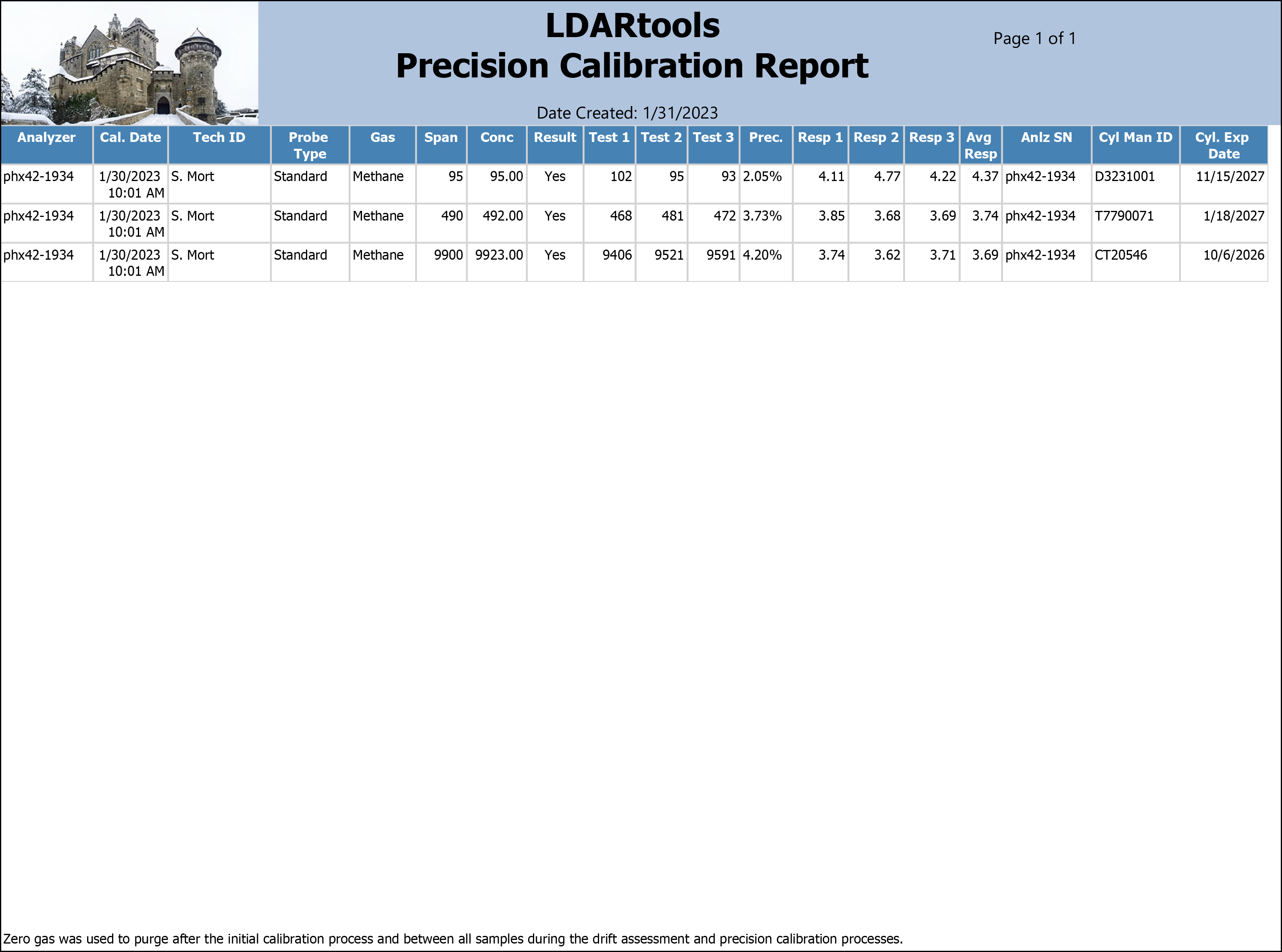
What the rows illustrate:
- phx42-1934 (490 span) — Average reading of 474 PPM vs. 492 PPM actual; Prec = 3.73%. Average response time = 3.74 seconds across all three tests.
- phx42-1934 (95 span) — Smaller range gas; three readings very close to concentration; Prec = 2.05%.
- phx42-1934 (9900 span) — All three readings close to 9500 PPM; Prec = 4.20%.
Output format
One row per gas cylinder per precision calibration session, ordered by calibration time and analyzer. Suitable for on-screen viewing, PDF, and Excel export.
Related reports
- Daily Calibration — daily span and zero gas calibration readings (not precision calibration).
- Analyzer Drift — drift checks performed during field use, based on the same calibration session.