Analyzer Drift
Published: 2026-06-18 Revised: 2026-06-18
What This Report Does
Reports drift check results for analyzers that were drifted using the Standard drift method. A drift check is a spot reading taken during the day to verify that the analyzer is still reading accurately relative to the morning calibration. Each row shows the morning calibration reading for a cylinder, followed by the mid-day (Drift 1) and end-of-day (Drift 2) drift check readings and their percent deviation.
Use this report to verify that analyzers remained within acceptable drift limits throughout the inspection day, and to document drift results for regulatory requirements. This report is in the Calibration folder on the Reports tab.
When to use it
- Reviewing morning calibration readings alongside intra-day drift results.
- Confirming that drift checks were performed and that all readings passed.
- Producing drift documentation for an audit or regulatory submission.
- Identifying analyzers that exceeded drift limits during a period.
Parameters
| Parameter | Description | Required | How it filters |
|---|---|---|---|
| Start Date | Start of the date window | Yes | Calibration dates on or after this date are included |
| End Date | End of the date window | Yes | Calibration dates on or before this date are included |
| Analyzers | One or more analyzers to include | Yes | Only records for the selected analyzers appear |
Analyzer list is date-filtered. The Analyzers parameter only shows analyzers with a Standard drift record in the database for the selected date range.
Columns
| Column | What it shows | Format / Notes |
|---|---|---|
| Analyzer | Analyzer device name | Text |
| Date | Date the calibration and drift checks were performed | Date; facility local time |
| Tech Id | Technician who performed the calibration | Text |
| Calibrate | Time of the morning calibration reading | Time (H:MM:SS AM/PM) |
| Cylinder | Cylinder label or serial number | Text |
| Cyl. Exp | Cylinder expiration date | Date |
| Conc. | Cylinder gas concentration in PPM | Integer |
| Reading | Morning calibration reading in PPM | Decimal |
| Pass | Whether the morning calibration passed | "Yes" or "No" |
| Drift1 | Time of the mid-day drift check (Drift 1) | Time (H:MM:SS AM/PM); blank if no mid-day drift performed |
| Drift1 Results | Mid-day drift check reading in PPM | Decimal; blank if no mid-day drift |
| Pct. | Mid-day drift percent deviation | Percentage; blank if no mid-day drift |
| Pass | Whether the mid-day drift passed | "Yes" or "No"; blank if no mid-day drift |
| Drift2 | Time of the end-of-day drift check (Drift 2) | Time (H:MM:SS AM/PM); blank if no end-of-day drift |
| Drift2 Results | End-of-day drift check reading in PPM | Decimal; blank if no end-of-day drift |
| Pct. | End-of-day drift percent deviation | Percentage; blank if no end-of-day drift |
| Pass | Whether the end-of-day drift passed | "Yes" or "No"; blank if no end-of-day drift |
| Ext Probe | Whether an extension probe was used | "Yes" or "No" |
What's Included and Excluded
Included:
- Calibration records (morning readings) for the selected analyzers within the date range.
- Drift 1 (mid-day) readings matched to the morning calibration.
- Drift 2 (end-of-day) readings matched to the morning calibration.
Excluded:
- Analyzers not selected.
- Records outside the date range.
- Analyzers drifted using the VVa method — a three-reading EPA drift method (40 CFR Part 60, Appendix F, Method VVa) — those appear in the VVa Drift report.
- Zero gas rows do not show drift percent values (no drift calculation for zero gas).
How Key Values are Calculated
Drift Percent
The percent deviation between the drift reading and the morning calibration is calculated according to the drift method configured in the analyzer's calibration settings:
| Setting | Formula |
|---|---|
| VVa 60.485a | (Drift − Calibration Reading) ÷ Cylinder Concentration × 100 |
| Calibration PPM | (Drift − Calibration Reading) ÷ Calibration Reading × 100 |
| Cylinder PPM (default) | (Drift − Cylinder Concentration) ÷ Cylinder Concentration × 100 |
A value of 0% means the drift reading exactly matched the reference value. Negative values indicate the analyzer is reading lower than expected; positive values indicate higher.
Drift 1 vs Drift 2
- Drift 1 is the mid-day (Noon) drift check, taken partway through the inspection shift.
- Drift 2 is the end-of-day drift check, taken at the end of the shift.
Not all sessions will have both; either drift may be blank if that check was not performed.
Tips and Common Questions
- "Drift columns are blank for some rows." If no mid-day or end-of-day drift was performed for that calibration session, the corresponding Drift columns will be blank. Zero gas rows also never show drift percent values.
- "There are multiple rows per analyzer per date." Each cylinder used in the morning calibration produces one row. A typical session includes a zero gas and several span gases.
- "Ext Probe = Yes but the morning calibration used Standard." Ext Probe reflects whether the calibration activity used an extension probe. A session can include both Standard and Extension probe readings on different gas cylinders.
- "The Pct. sign is negative — does that mean it failed?" A negative percent deviation means the analyzer is reading lower than expected. Whether this is a pass or fail depends on your site's drift limit (typically ±10% or ±20% depending on the regulation). Check the Pass column for the actual pass/fail result.
- "This report only shows Standard drift — where is VVa drift?" Analyzers drifted using the VVa method appear in the VVa Drift or VVa Drift – Form 2 reports instead.
Sample Output
Report run for Example Facility, Start Date: 9/22/2022, End Date: 9/22/2022, Analyzers: phx42-3536, phx42-3584, phx42-3590, phx42-3599, and phx42-5389.
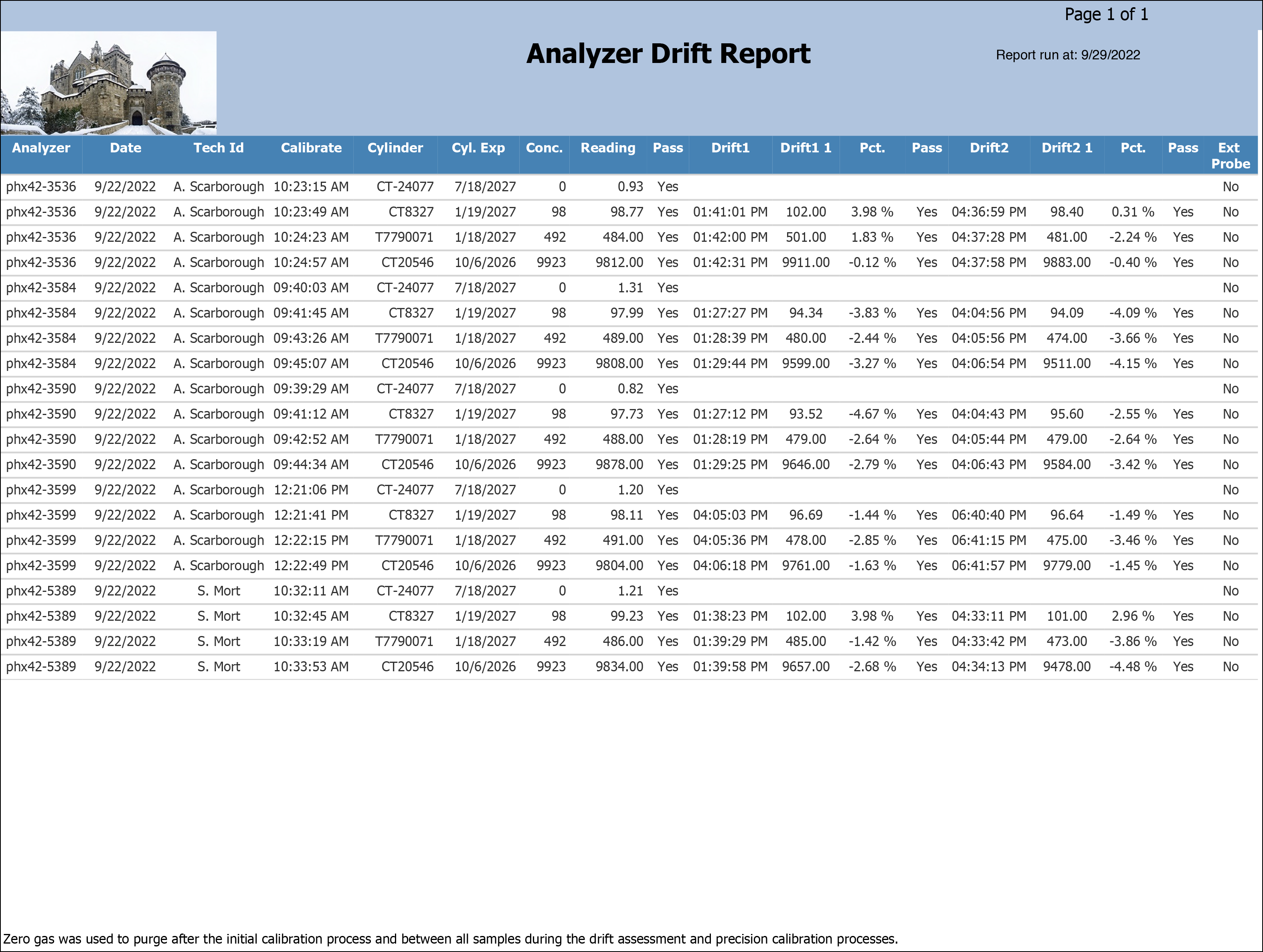
What the rows illustrate:
- CT-24077 (zero gas) — Zero gas row; no drift percent shown. Drift1/Drift2 columns are blank.
- phx42-3536 (CT8327) — Drift 1 at 1:41 PM showing −3.98%; Drift 2 at 4:36 PM showing −0.31%. Both pass. The analyzer is drifting lower throughout the day but remains within limits.
- phx42-3536 (T7790071) — Smaller drift values than before across both mid-day and end-of-day checks; well within acceptable limits.
Output Format
One row per gas cylinder per morning calibration session. Drift 1 and Drift 2 readings appear as additional columns in the same row. Suitable for on-screen viewing, PDF, and Excel export.
Related Reports
- VVa Drift — drift checks performed using the VVa method (three readings per drift event, NSPS (New Source Performance Standards) VVa and Consent Decree compliance columns).
- VVa Drift – Form 2 — simplified VVa drift format with Cal Note column.
- Daily Calibration — the morning calibration readings without the drift check columns.